
Festive Season Sales 2026 :
What to Buy, How to Find Deals.

Festive shopping is moving into its busiest phase, and shoppers have more sale options than ever. The smart move is not to chase every discount; it is to prepare a shortlist, compare the real price and buy only what makes sense.
The festive shopping season is officially getting serious
The festive shopping season is officially getting serious. In India, shoppers are already searching for Diwali sales and planning purchases weeks before the biggest offer days arrive. Google says interest in “Diwali sales” began rising as early as August, while 2026 sale announcements from major marketplaces show that October is becoming the key starting point for online festive shopping. Amazon’s Great Indian Festival begins on October 8, while Flipkart has early access on October 8 and general access from October 9. Dussehra falls on October 20 and Diwali on November 8 in 2026. In other words, the sale season is not “coming” anymore it is already starting.
But here is the catch: the biggest discount is not always the best deal. During a festive sale, prices move quickly, bank offers can change the final amount, and an attractive banner can make an unnecessary purchase feel urgent. A smarter approach is to decide what you actually need, track prices, compare offers, and keep your shortlist ready before the sale rush begins.
What is coming in the 2026 festive sale season?
Expect the next few weeks to be crowded with offers across electronics, fashion, beauty, home essentials, appliances, mobiles, accessories and everyday products. The exact offers vary by platform and brand, but the pattern is familiar: early deals create attention, the main sale days create urgency, and category-specific offers appear throughout the season.
This is also becoming a more research-heavy shopping season. Google’s India festive research says nine in ten shoppers who purchased during Navratri/Diwali reported researching beforehand, and shoppers averaged multiple online searches and videos during the journey. That means people are not simply waiting for a discount. They are checking reviews, comparing prices, looking at alternatives and trying to decide whether the deal is actually worth it.
Which products are usually worth watching during festive sales?
Start with products where the difference between the regular price and sale price can be meaningful. Smartphones, laptops, tablets, televisions, headphones, smartwatches, kitchen appliances, air conditioners and large home appliances often attract strong attention. Fashion and beauty can also become more interesting when additional bank offers, coupons or bundle deals stack on top of an already reduced price.
For lower-ticket purchases, look for useful upgrades rather than buying simply because an item is marked “50% off”. A good festive purchase is something you were likely to buy anyway, now available at a better effective price.
How to spot a real festive deal
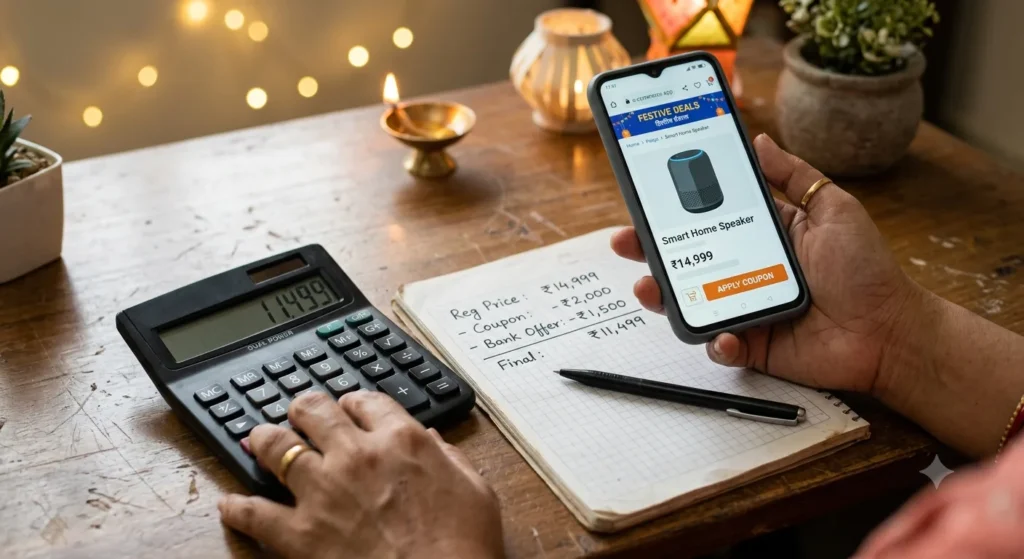
A sale tag alone tells you very little. Look at the final payable price after coupons, bank discounts, exchange benefits, membership benefits and delivery charges. Then compare that price with what the same product was selling for recently.
Another simple trick is to compare versions, not just brands. A slightly older model may offer most of the features you need at a much better price than the newest model. Also check warranty, seller rating, return policy and product authenticity before purchasing. Saving money is only a good deal when you are still happy with the product after it arrives.
Why your wishlist matters before the sale
The worst time to start deciding what you want is when the countdown timer hits zero. Create a shortlist before the sale starts. Separate it into “need now”, “good deal only” and “skip unless price drops significantly”.
This is where Baggyfy can be useful. Instead of opening dozens of tabs and trying to remember where you saw something, shoppers can use Baggyfy to organize products they are considering across different shopping needs. The idea is simple: save what matters first, compare when the sale arrives, and avoid making every decision in the middle of the sale rush.
Why your Wishlist matters before the sale
If your list is still too broad, divide it into four simple buckets: technology, fashion and beauty, home, and everyday essentials. Technology is best approached with a model-specific price target because specifications can make “cheaper” versions very different. Fashion is more about size, fabric, return policy and actual usefulness than the percentage shown on the product page. For beauty, check ingredients, seller credibility and expiry information. For home products, compare energy use, warranty and service support along with the sale price.
One more rule: stack discounts carefully. A bank offer, coupon, cashback and exchange bonus can look like four separate savings, but only some may apply to the same order. Read the conditions before counting the saving in your budget.

A simple festive shopping strategy
Start with a budget. Then create a product list. Next, note the normal selling price or your expected price for each item. During the sale, compare the effective price rather than the headline discount.
For example, suppose a product is listed at ₹20,000 with a “20% off” banner. The sale price may be ₹16,000, but an eligible bank offer or coupon could reduce the final cost further. On the other hand, an exchange condition or membership requirement could make the offer less useful for you. The real question is not “How big is the discount?” It is “What will I actually pay, and is this the best value for what I need?”
Do not shop only on the biggest sale day
Festive sales are often stretched across several phases. Early-access offers can appear before the main event, flash deals can sell out quickly, and some categories may become more attractive later in the season.
That is why it makes sense to track your shortlist instead of chasing every notification. A product that is genuinely useful today can be a good buy even if the price falls by a small amount later. But for a big-ticket purchase, waiting and comparing can be worthwhile.
Also consider delivery timelines. If you need the product
urgently, paying a slight premium for same-day or next-day
delivery might be worth it.
The rise of AI is changing festive shopping
Festive shopping is also becoming more conversational. Instead of searching only “best phone under ₹30,000”, shoppers may ask an AI tool questions such as “Which phone is better for camera and battery?” or “What should I buy during Diwali sales if I want a laptop for office work?”
Amazon has already highlighted AI-powered shopping features such as Rufus, Lens and price-history tools for festive shopping. This shows where online shopping is heading: people want help narrowing choices, understanding trade-offs and reaching a decision faster.
For shoppers, that means the best deal is not just the lowest price. It is the right product, at the right effective price, with enough confidence to complete the purchase.

What should you do before the sales begin?
Do not wait for sale banners to tell you what to buy. Make your list now. Check what you already own. Identify what actually needs replacement. Save a few alternatives. Set your budget. Read the return and warranty terms. Then watch the offers with a plan.
Festive sales can genuinely save money, especially when a necessary purchase lines up with a strong discount. They can also encourage impulse buying disguised as urgency. The difference is preparation.
This is exactly the problem that Baggyfy was built to solve.
Baggyfy is a free Indian wishlist platform that lets you save
product links from Amazon, Flipkart, Meesho, Myntra, and 50+
other stores into organised folders – all in one place.
Quick Tips to Always Get the Best Price Online
Beyond the step-by-step comparison process, here are some
additional tips that experienced online shoppers in India
swear by:
Shop During Major Sale Events
The biggest price drops of the year happen during Amazon’s
Great Indian Festival (October) and Flipkart’s
Big Billion Days (October). Electronics, appliances, and
fashion see discounts of 30-70% during these events. If your
purchase is not urgent, waiting for these sales can save you
a significant amount.
Use Incognito Mode When Browsing
Some e-commerce platforms use dynamic pricing algorithms that
may show higher prices to users who have repeatedly visited
the same product page. Opening the product in an incognito
or private browser window removes this tracking and may
reveal lower prices.
Check the Product on the Brand’s Own Website
For brands like boAt, Samsung, Apple, Puma, and Nike – the
brand’s official website sometimes runs exclusive deals that
are cheaper than both Amazon and Flipkart. Always check the
brand’s website as part of your comparison, especially during
festive seasons.
Read Reviews Before Trusting a Low Price
An unusually low price is sometimes a red flag. Always read
recent buyer reviews and check the seller rating before
choosing the cheapest option. A product that fails within a
month and cannot be returned is not a deal – it is a loss.
Final Thoughts
The best festive shopper is not the person who buys the most. It is the person who knows what to buy, knows what price feels right, and is willing to skip a “deal” when it is not really a deal.
This festive season, shop with a shortlist instead of a shopping frenzy. Compare before you click, keep your options organized, and let the sale work for your budget not the other way around.
Frequently Asked Questions
When are the biggest festive sales in India in 2026?
Major online festive sale activity begins in October. Amazon’s Great Indian Festival starts October 8, while Flipkart has early access on October 8 and general access from October 9. Dussehra is October 20 and Diwali is November 8, so shoppers can expect multiple sale waves rather than one single day.
Which products are usually best to buy during festive sales?
| Compare products you already planned to buy, especially higher-value items such as smartphones, laptops, TVs, appliances and useful upgrades. For fashion, beauty and everyday products, focus on the final price, quality, return policy and seller credibility rather than the discount percentage alone. |
How can I tell whether a festive sale discount is actually good?
Check the final payable price after coupons, bank offers, exchange benefits and delivery charges. Compare it with the product’s recent selling price and check warranty, returns and seller information before purchasing.
Should I buy early or wait for the main Diwali sale?
It depends on the product and your price target. Early-access deals can be useful, while some categories may see later offers. For expensive purchases, keep two or three alternatives saved so you can compare before committing.
How do I avoid impulse buying during festive sales?
Create a shortlist before the sale, set a budget and label items as “need now”, “good deal only” or “skip unless price drops significantly”. This makes it easier to ignore countdown pressure and buy with a plan.
Major online festive sale activity begins in October. Amazon’s Great Indian Festival starts October 8, while Flipkart has early access on October 8 and general access from October 9. Dussehra is October 20 and Diwali is November 8, so shoppers can expect multiple sale waves rather than one single day.
| Compare products you already planned to buy, especially higher-value items such as smartphones, laptops, TVs, appliances and useful upgrades. For fashion, beauty and everyday products, focus on the final price, quality, return policy and seller credibility rather than the discount percentage alone. |
Check the final payable price after coupons, bank offers, exchange benefits and delivery charges. Compare it with the product’s recent selling price and check warranty, returns and seller information before purchasing.
It depends on the product and your price target. Early-access deals can be useful, while some categories may see later offers. For expensive purchases, keep two or three alternatives saved so you can compare before committing.
Create a shortlist before the sale, set a budget and label items as “need now”, “good deal only” or “skip unless price drops significantly”. This makes it easier to ignore countdown pressure and buy with a plan.