
The Problem with Shopping Across Multiple Apps
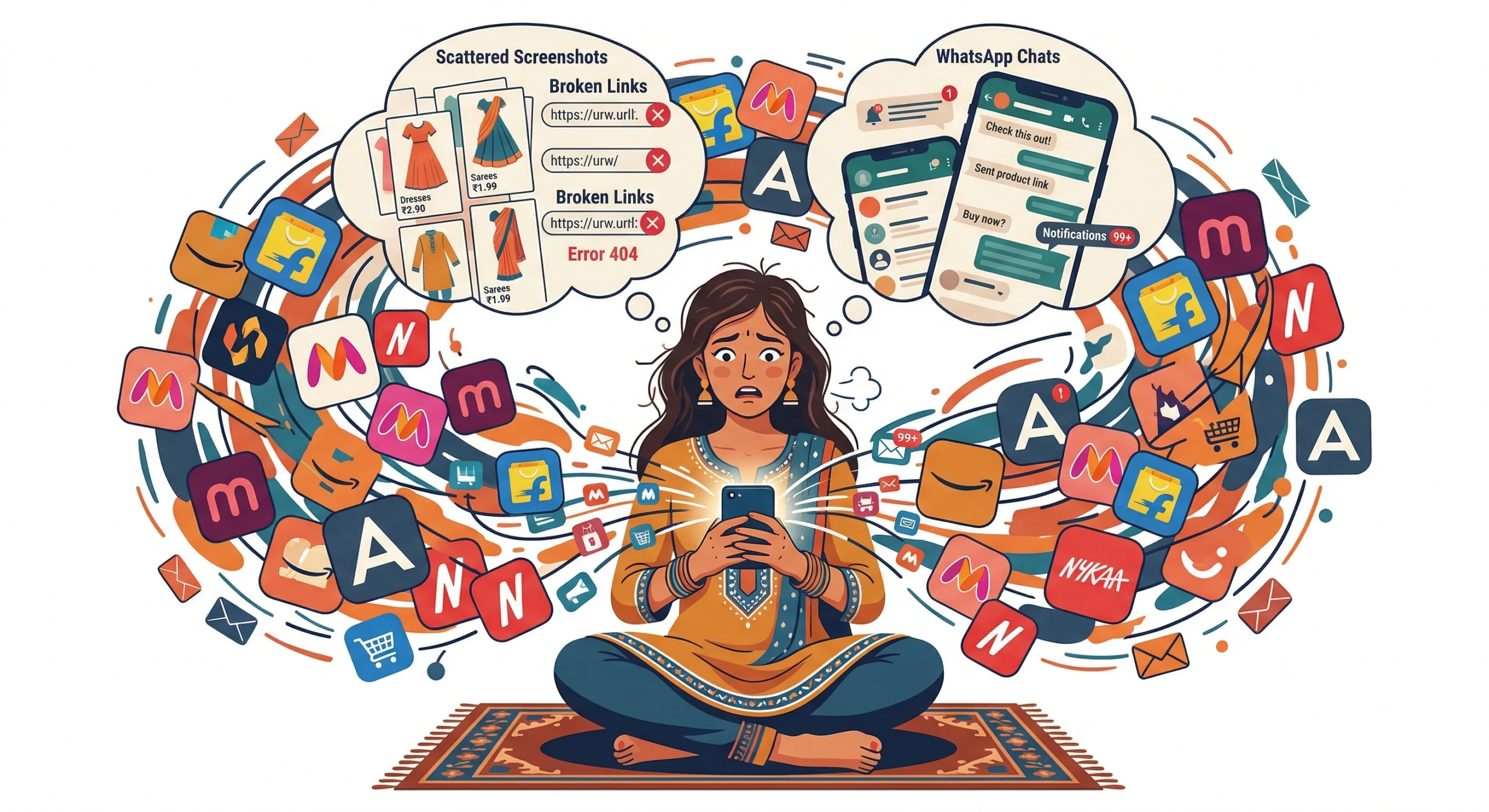
India has more Shopping Apps than ever and that's the Problem
Your Myntra wishlist doesn’t know what’s in your Amazon cart. Your Meesho saves have nothing to do with your Flipkart history. Every app is its own silo, its own universe. And the moment you step out of one, everything you found inside it effectively disappears – unless you remember to come back.
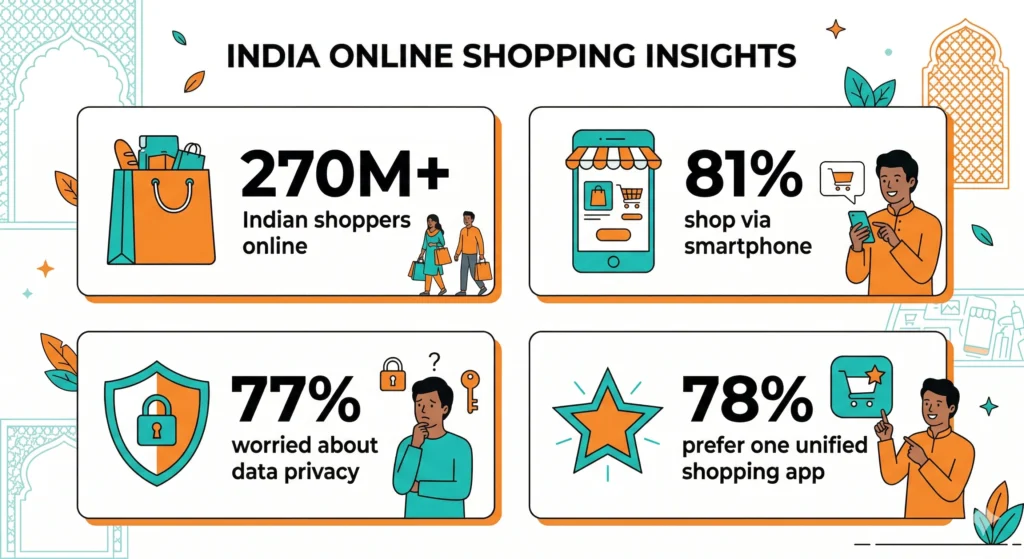
81% of Indian shoppers use smartphones but phones weren't built for this
72% of Indian consumers make online purchases most often via mobile apps, and 81% of e-commerce shoppers in India use smart phones or mobile devices for their purchases. But phones aren’t designed to help you manage a fragmented shopping life across seven different apps. You get one screen, one active app at a time, and no universal way to save, compare, or revisit products across platforms.
The result? You either keep all those apps open simultaneously and drain your battery, or you lose your place every time you switch. There is no middle ground.
The 5 Real problems nobody talks about
Multi-app shopping feels normal because everyone does it. But normal doesn’t mean efficient. Here are the five biggest problems Indian shoppers silently deal with every day.
1. Products Get Lost Between Apps
You discover something you love on Meesho – a kurta set that’s exactly your style and within budget. You close the app to check if it’s available on Amazon or Flipkart for faster delivery. When you come back to Meesho, you can’t find it again. The algorithm has moved on. The product has disappeared from your feed. Your search history doesn’t help. It’s just gone.
This isn’t rare. It happens to Indian shoppers dozens of times a week. And every lost product is a frustration that compounds over time.
2. Comparing Prices Across Apps Is Nearly Impossible
Smart shopping means comparing prices. But comparing a product across Amazon, Flipkart, and Meesho in real time requires you to have all three apps open at once, manually search for the same product in each, check for similar seller names, read three separate review sections, and mentally track three different prices – all without a way to pin them side by side.
Most shoppers give up halfway and just buy from wherever they’re already browsing. That means they’re almost certainly not getting the best price.
3. Screenshots Don't Scale
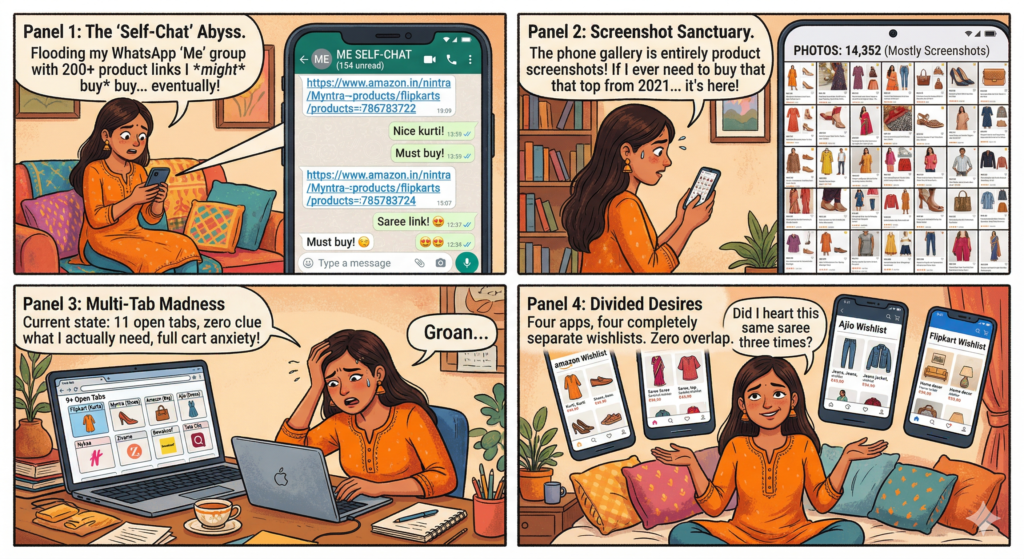
The screenshot habit is universal among Indian shoppers. See something good, screenshot it, deal with it later. But “later” arrives, and your gallery has 40 product screenshots from the past two weeks – most without prices, none with links, and all of them out of context. Which screenshot was from Amazon? Which was Nykaa? Was that price still valid?
Screenshots were never meant to be a shopping tool. They just became one by accident.
4. Data Privacy across multiple Apps is a Growing Risk
Here’s a 2025 problem that’s getting louder: 77% of Indian consumers are worried about data breaches when shopping online, and 73% worry their personal details may be exposed. Every shopping app you install requests permissions – your location, contacts, camera, sometimes microphone. The more apps you use, the larger your data footprint.
Shopping across seven platforms means seven different companies have your phone number, address, payment history, and behavioural data. Most shoppers don’t think about this until something goes wrong.
5. Sale Events create impossible decision pressure
Big Billion Days, Great Indian Festival, End of Reason Sale, Nykaa’s Pink Friday – India’s shopping calendar is packed with sale events that run simultaneously across platforms, each for limited hours. When the sale starts, you need to know exactly what you want and where to find it – fast.
But if your wishlist is scattered across screenshots, browser tabs, and WhatsApp messages, you waste the first 30 minutes of a 6-hour flash sale just trying to remember what you wanted to buy. By the time you find it, the deal is gone.
Why This Problem Is Getting Worse in 2025, Not Better
You might expect that with more technology, this problem would solve itself. In some ways, the apps are getting smarter apps that learn from your behavior, what you pause on, scroll past, or cart and abandon, now dominate India’s e-commerce landscape. AI-powered outfit suggestions, visual search, personalized feeds. The discovery experience is genuinely improving within each app.
But that improvement is happening in isolation. Each app is getting better at keeping you inside its walls. None of them is getting better at helping you shop across all of them.
The Super App Dream - Still Unfulfilled for Indian Shoppers
53% of Indian shoppers are familiar with super apps, and 78% prefer them over single-category apps. The demand is clearly there. Indian shoppers want one place to discover, compare, save, and buy. But no single platform serves every category, every price point, and every seller. Amazon doesn’t have Meesho’s prices. Flipkart doesn’t have Myntra’s curation. Myntra doesn’t have Nykaa’s beauty range.
Until a true super app arrives and one that every seller joins Indian shoppers will keep juggling. The question is what you use to manage the juggling in the meantime.
How Indian Shoppers Are Currently Coping - And Why It Isn't Working
In the absence of a proper solution, Indian shoppers have developed workarounds. None of them were designed for shopping, and none of them work particularly well.
The WhatsApp-to-self method
Copying product links and sending them to yourself on WhatsApp is the most common workaround. It works until your selfchat becomes a graveyard of unsorted links with no context, no images, no prices, and no way to tell which link came from which platform.
The Browser Bookmark Chaos
The Screenshot Gallery System
Platform Wishlists - Each One Stuck Inside Its Own App
The Smarter Way to Shop Across All Indian Apps in 2025
The solution isn’t to shop on fewer platforms – that would mean giving up better prices or better products. The solution is to have one central place outside all the platforms where you can save, organise, and compare everything you find.
This is exactly what Baggyfy is built for.
One Wishlist for Every Indian Shopping Platform
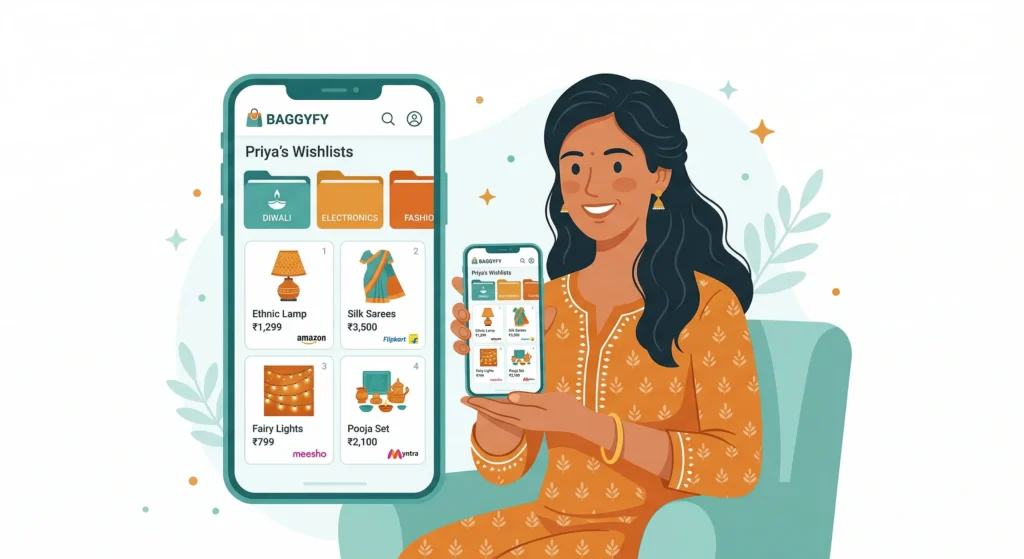
Baggyfy is a free, web-based wishlist organiser that works with Amazon India, Flipkart, Meesho, Myntra, Nykaa, Ajio, and 1000+ other Indian and global stores. You copy a product link from any app, paste it into Baggyfy, and it automatically pulls the product image, name, and price into your organised folder.
No app download. No account juggling. One Google login. Works on any device.
Folders for the Way Indian Shoppers Actually Think
You can create folders that match how you naturally shop – “Diwali Shopping,” “Electronics Wishlist,” “Ghar ke Liye,” “Gifting Ideas,” or “Bas Thoda Ruko” (for everything you want but aren’t buying just yet). Every product you save lands in the right folder with context not in a random gallery or a cluttered self-chat.
The Sale Strategy That Actually Works
Save everything you want to buy across all platforms into your Baggyfy folders before a sale. When Big Billion Days or Great Indian Festival starts, open Baggyfy your cross-platform list is ready. No scrambling. No forgotten links. No losing the deal because you couldn’t find the product fast enough.
timing. Neither platform is consistently cheaper across
all products. However, there are some general patterns that
Indian shoppers have observed over time.
The Real Cost of Shopping App Chaos
It’s easy to dismiss this as a minor inconvenience. But the real cost adds up. You buy the wrong product because you couldn’t compare properly. You miss a sale because your list wasn’t ready. You overpay because you didn’t check another platform. You buy something impulsively and regret it because you didn’t give yourself time to think.
Shopping app chaos is not just an organisational problem. It’s a financial one. Better organisation means better decisions. Better decisions mean better value for your money.
In 2025, with India’s e-commerce market growing faster than ever and more platforms launching every quarter, the number of apps you juggle is only going to increase. The smarter move is to set up a system now before your gallery hits 200 product screenshots.
Frequently Asked Questions
Is shopping across multiple apps really that common in India?
Yes. With Meesho dominating affordable fashion, Flipkart leading in electronics, Amazon strong in branded products, and Myntra and Nykaa specialising in fashion and beauty, the average Indian shopper uses 4–6 apps regularly. There is no single platform that covers all categories and price points.
Why don't shopping apps just build a cross-platform wishlist?
Each platform has a commercial interest in keeping you inside their app. A cross-platform wishlist would drive traffic to competitors, which is why no major platform will build one. The solution has to come from a neutral third-party tool like Baggyfy.
Is it safe to use a wishlist tool across multiple platforms?
Yes. Baggyfy doesn’t require you to share your login credentials for any platform. You simply copy and paste product links – no access to your accounts, no passwords shared. Your data stays where it belongs.
Will Baggyfy work during flash sales like Big Billion Days?
Absolutely. In fact, sale seasons are when Baggyfy is most useful. Save everything you want beforehand in organised folders, and when the sale starts you’re ready to act immediately – no wasted time searching.
Stop Shopping in Chaos. Start Shopping with a System.
India’s online shopping market is extraordinary. The variety, the prices, the delivery speeds Indian consumers have access to one of the most competitive e-commerce ecosystems in the world. But that ecosystem is fragmented by design.
Until the super app dream becomes reality and it hasn’t yet the smartest thing you can do is build your own system. One place where everything you find across every platform lives together, neatly, ready for when you need it.
Baggyfy.in – free, no download, works on any device. Sign in with Google and create your first folder in under 30 seconds. Your most organised shopping life starts today.
Hopping on websites is such a pain. Thank you baggyfy
Before baggyfy saving and remember was such a job. Thank you baggyfy